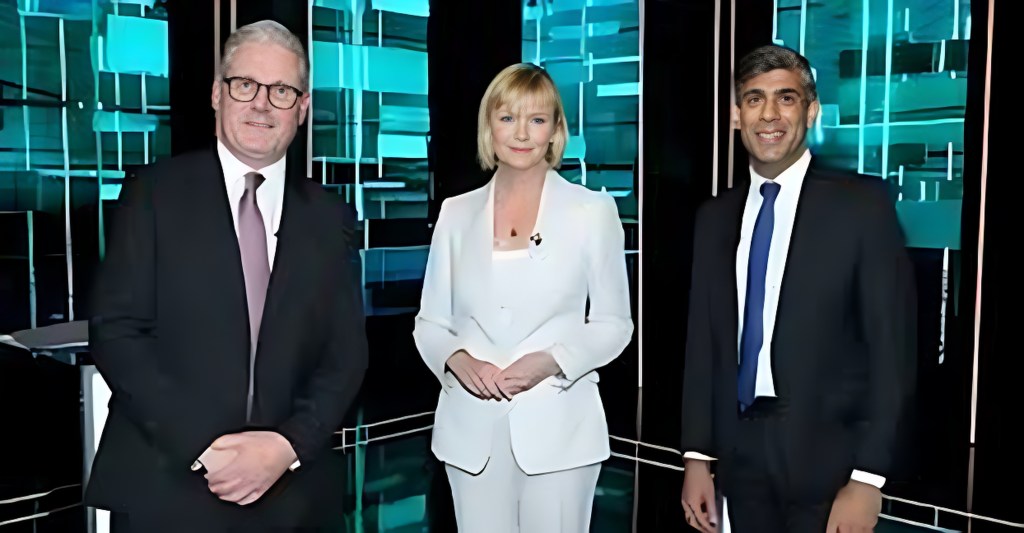
The first debate of the 2024 UK General Election was broadcast on ITV and saw Rishi Sunak head-to-head with Sir Keir Starmer as they discussed devisive issues such as the Rwanda policy and the cost of living crisis that is affecting the UK at the moment.
The voting intention for Labour (according to the Guardian) increased from 44.6% on the 28th to 44.8% on the 29th, showing that viewers were affected positively by Keir Starmer that day, and this could be down to his portrayal on the debate. He tried to connect with the audience, showing off his relatability as “one of the people”. He said his dad was a toolmaker three times, that his mum was a nurse twice. If you were to take a shot for every time Keir Starmer tried to convince you he was relatable, you’d probably have been out of it by the time the debate ended.
The voting intention for the Conservatives (according to the Guardian) also increased from 23.2% on the 28th to 23.6% on the 29th (a 0.2% more increase than Labour) which could also be down to the debate. Rishi Sunak provided his plans, albeit if they were exposed by Keir Starmer for not being viable policies.
However, according to YouGov, 85% of the respondees to their Snap Poll on the televised debate voted Conservative in 2019. When asked who those polled thought won the debate, 46% said they thought Rishi Sunak won, compared to 45% for Keir Starmer. However, 60% said they thought Keir Starmer performed better, whilst 55% said they thought Rishi Sunak performed well. These numbers being very high show that there is a large amount of voters who thought both Sunak and Starmer performed well, potentially showing a high amount of partisan dealignment within the electorate as they become undecided on who they think is the better debater, showing there is also confusion on who would be the better leader.
This confusion in who people thought won is explainable. Both leaders said over double negative comments about the other’s plans compared to what thought-through plans they proposed to the general public.
This was the ‘Debate Score Sheet’ provided by Simple Politics (@simplepolitics on Instagram) which outlines the positives and negatives of what both leaders provided to the public about their own plans, and what criticisms they had of the other leader’s plans.

As we can see, and as Simple Politics rightfully points out in the footer of their post, the general public is being consistently provided with negativity. We should be shown positive plans from both parties on how they will improve life in a harsh cost of living crisis that has severely impacted millions as prices have risen and wages have stayed the same and not risen with inflation. The climate is deteriorating by the day, there are international conflicts, there is still inequality as we see things like the Gender Pay Gap not being closed any time soon, and there is a lack of representation in Parliament. And yes, those plans to tackle these negativities are there. But are they well publicised? Not very. For every “here’s what we’ll do”, there are 3 “and here’s what they won’t do”. Opening up X (formerly Twitter) is a tidal wave of negativity now with attack ads being pushed from both parties. As young voters enter the world of voting and see these attacks, they become less enthusiastic about politics as they worry that “all parties are the same” and they “don’t know what they stand for”. It is creating a participation crisis within the UK as voters are detracted from going to vote, and it needs to be solved.
As we see Manifestos come out in the coming weeks, hopefully we will be seeing more coverage in debates and by large media firms on policies rather than covering who has attacked who now.
The Public Gallery will cover the manifestos as they come out, so stay tuned.
 The Public Gallery
Leave a comment